


Networked Intelligent Timed Voice Reminder Solution Fully Released
Hello everyone,
Today we are officially releasing: the Networked Intelligent Timed Voice Reminder Solution is now fully available.
This is not a product description confined to feature specifications, but a complete implementation package covering “hardware design, interface protocols, production testing, display expansion, and development resources.” At the same time, we are also providing the Music Alarm Core Board, an integrated product board that makes it easy to evaluate features, rapidly validate the solution, and shorten development cycles.
1. Networked Timed Voice Reminder Capabilities for Real-World Scenarios
The core goal of this solution is not to build an ordinary clock that “shows the time,” but to deliver networked intelligent timed reminders and automatic ringing capabilities that are truly suitable for multiple scenarios.
It is particularly well-suited for the following scenarios:
- Schools & Training Institutions: class bells, course change reminders, automatic holiday adaptation
- Factories & Workshops: shift broadcasts, on/off-duty reminders, safety alert announcements
- Hospitals & Nursing Homes: nursing shift changes, medication reminders, activity time alerts
- Offices & Retail Stores: business hour broadcasts, meeting reminders, lunch break alerts
- Other Public Settings: exam bells, gymnasium timed announcements, worship or event reminders
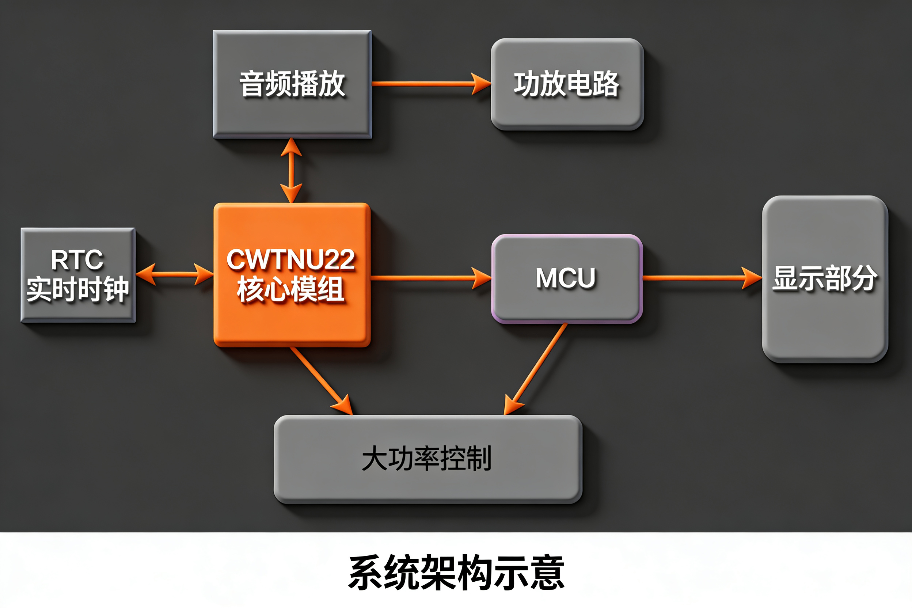
Compared to traditional timers, this solution has already organized WiFi connectivity, NTP time sync, alarm scheduling, holiday adaptation, audio decoding, and web configuration into a ready-to-deploy integrated package. Developers no longer need to piece together complex software logic from scratch.
2. Integrated Product Board: Faster Validation & Direct Deployment
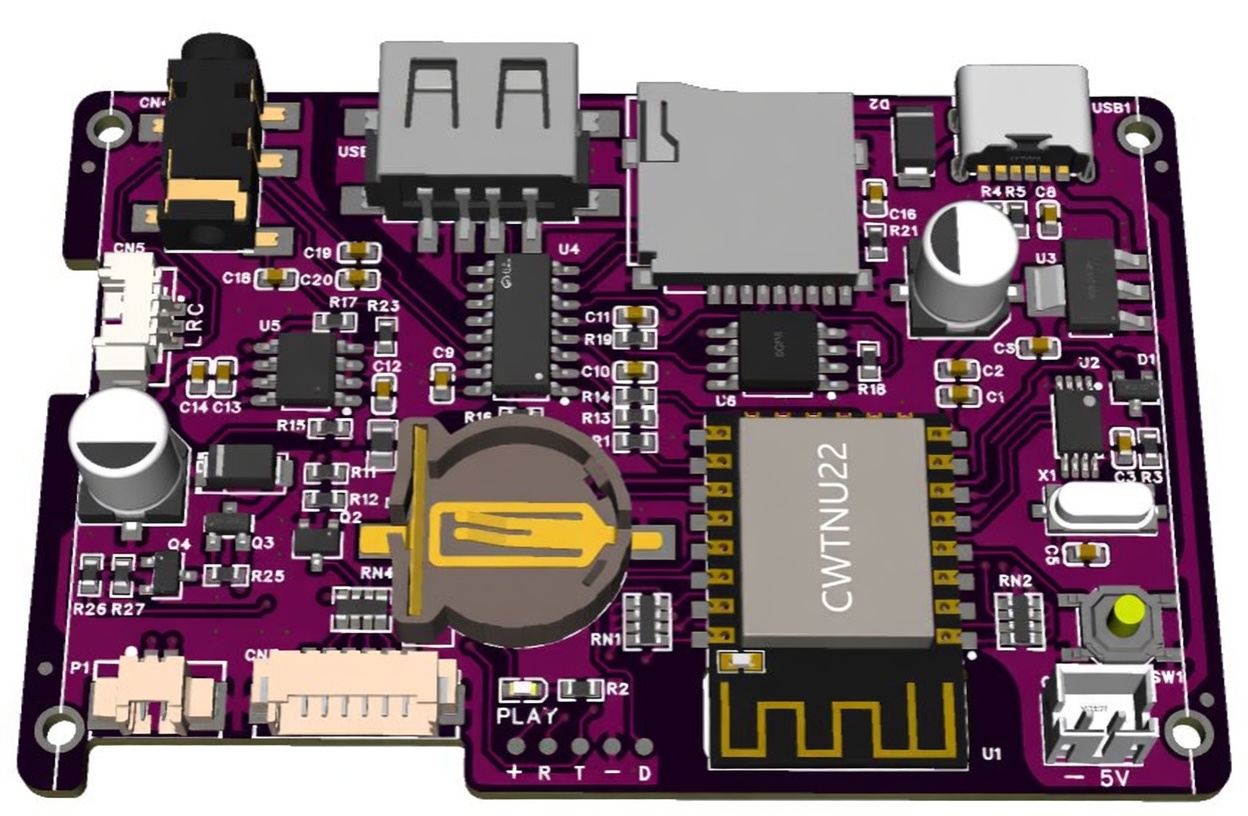
Under this solution, we are simultaneously providing the Music Alarm Core Board, an integrated product board that directly incorporates many of the most time-consuming key capabilities:
- High-precision network timekeeping: Supports WiFi connectivity and NTP automatic time sync, configurable primary/backup servers, timezone, and automatic DST.
- Rich time announcement modes: Supports Chinese and English bilingual voice time announcements, Westminster chimes, music time announcements, with independent settings for the hour, half-hour, 15-minute, and 45-minute marks.
- Large-capacity alarm scheduling: Supports at least 50 independent alarms, configurable with single, weekly, monthly, statutory workday, statutory holiday, and other modes.
- Flexible audio playback: Supports system ringtones, TF card, and USB drive audio playback, compatible with MP3/WAV, with single-track, loop, random, and other playback modes.
- Web configuration backend: Once the device connects to 2.4G WiFi, you can directly access the configuration via a browser using the LAN IP — no additional app required.
This means developers can focus their main efforts on peripheral design, user interface interaction, and overall enclosure structure, without repeatedly investing significant time in network time sync, holiday logic, ringtone scheduling, and other foundational capabilities.

3. More Than a Product Page — A Complete Development Solution
This solution is not simply a statement that “we support secondary development.” Instead, it systematically organizes the content truly needed during the productization process:
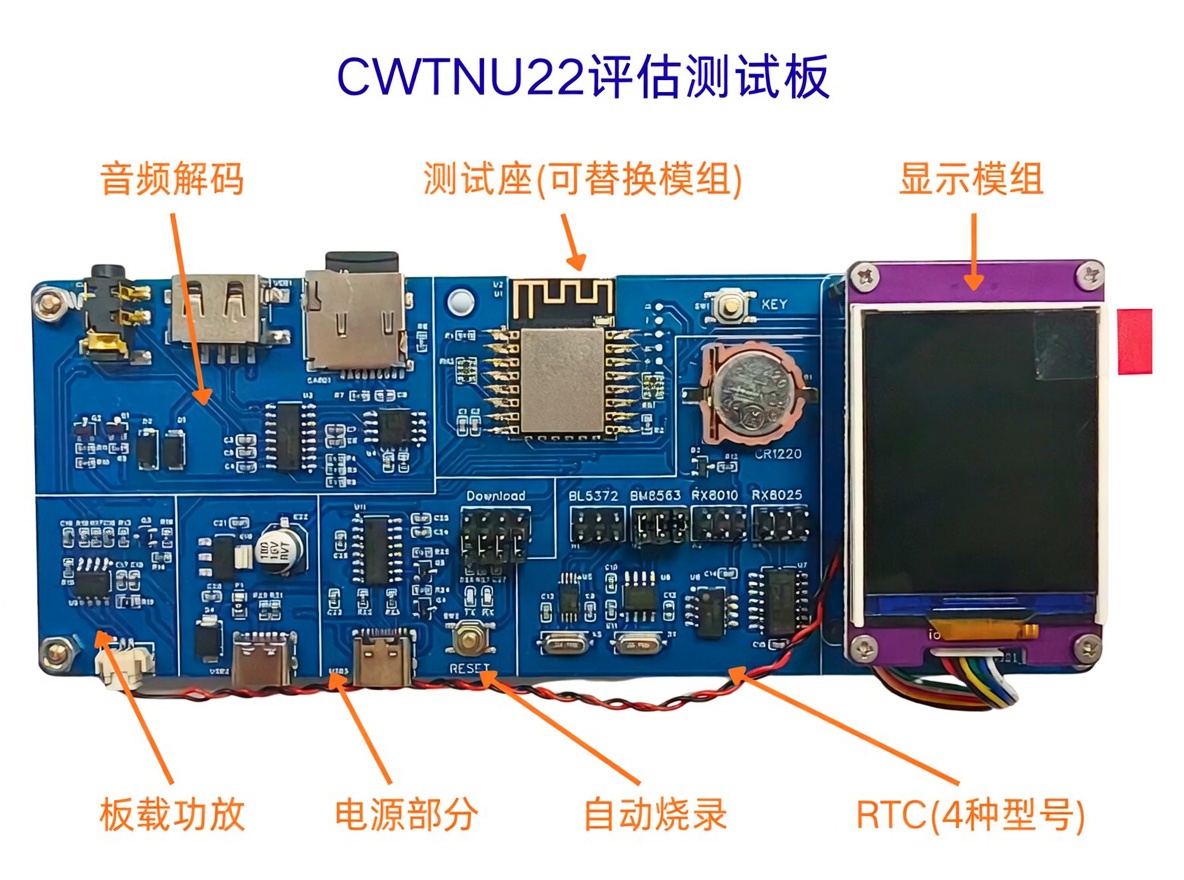
- Hardware Design Considerations: Including core module power supply design, audio decoding reference circuits, amplifier design recommendations, RTC selection guidelines, power-on level requirements, and more.
- Interface Protocol Documentation: Provides UART protocol output specifications, with 4 frames of information output per second, making it easy for MCUs to parse and drive LCD, OLED, or segment display.
- Display Module Reference Solution: Provides a 1.77-inch TFT LCD display module reference design, including schematics and sample code, to help quickly complete UI development.
- Production & Factory Testing Workflow: From Flash programming and component selection, to network testing, TF/USB drive playback verification, and RTC retention testing — all with clear execution procedures.
For teams that need to deliver products in volume, these supporting materials are more valuable than raw feature specifications alone, as they directly impact development timelines, stability, and mass production risk control.
4. Ample Room Reserved for Mass Production & Peripheral Expansion
In designing this solution, we paid special attention to the stage that is most prone to bottlenecks: “from prototype verification to mass production.”
For example:
- RTC Compatibility: Supports multiple common RTC chips, allowing users to choose based on cost, power consumption, and accuracy requirements.
- Scalable Audio System: The amplifier section can be retained or redesigned according to product positioning — suitable for both low-power devices and higher-power peripherals.
- Standardized Status Outputs: Through UART, 1PPS, PLAY_STATUS, and other signals, you can easily expand with displays, relays, professional amplifiers, or other control logic.
- Reusable Factory Testing Workflow: The solution provides finished product factory testing procedures, making it easy to establish standardized production inspection processes.
This design approach is particularly suitable for two types of users:
- Individual developers or makers who need to quickly produce stable prototypes
- Small to medium-sized device manufacturers or integrators who need to rapidly productize “timed voice reminder devices”
5. Materials Are Live — Start Evaluation & Development Now
Both documentation pages are now live, covering:
- User Guide
- Interface Protocol
- Hardware Design Notes
- Display Module Reference Materials
- Production & Factory Testing Workflow
- Downloads & Reference Projects
Direct access:
If you are evaluating product solutions in the areas of automatic ringing, timed broadcasting, voice reminders, or networked time-sync displays, the content released this time can already serve as a direct starting point for development.
We welcome your continued feedback and requirements. Going forward, we will continue to refine firmware capabilities, development resources, and supporting examples based on real-world usage, helping more users achieve productization faster.